Dev.Opera2024-02-09T17:20:16+00:00https://dev.opera.com/Dev.Opera editorshttps://dev.opera.com/blog/opera-wallet-integration-guide/Opera Wallet Integration Guide2022-03-08T00:00:00+00:002022-03-08T00:00:00+00:00Danny YaoOpera is one of the most popular browsers in the world, with more than 350 million active users. Opera’s built-in Crypto Wallet helps users access the world of Web3 without the complicated setup of other wallet applications.
By supporting the Opera Crypto Wallet, Dapp developers can gain access to millions of crypto users on Opera platform. To do so, Dapp developers need simply add a few lines of code to set up integration with the Opera Crypto Wallet.
Best Practice
There are two steps in requesting a user connect their Opera Crypto Wallet to your dApp, without the need for SDK installation.
Step 1: Detect whether the user is using Opera Wallet
Check the global variable to see if the client is Opera.
let isOperaWallet = false;
if(window.ethereum){
    isOperaWallet = window.ethereum.isOpera;
}
if(isOperaWallet){
    // add Opera Wallet as the first option in the wallet connection panel.
}
Step 2: Prompt user to connect the wallet
If they’re using the Opera Crypto Wallet, then you can request the user connect the wallet following EIP-1193. Opera Browser will then prompt the Opera Crypto Wallet and ask the user to connect the wallet to the Dapp.
The implementation of Opera Wallet follows EIP-1193. You can connect the wallet with library implemented EIP-1193, such as web3.js or ether.js.
Download Opera Crypto Browser
You can access the Opera Crypto Wallet by downloading Opera’s Crypto Browser. You can download it here.
To set up the wallet, click the wallet icon on the left sidebar. You can set up a new wallet or restore your existing wallet with your recovery phrase.
Switch network for the user
The wallet also covers implementation on EIP-3326. As a result, you can use wallet_switchEthereumChain to request the user switch networks. The wallet will display a popup allowing users to switch networks in one click.
Add network for the user
The wallet also covers implementation on EIP-3085. As a result, you can use wallet_addEthereumChain to request the user add a new network.
]]>https://dev.opera.com/blog/opera-58/What’s new in Chromium 71 and Opera 582019-01-23T00:00:00+00:002019-01-23T00:00:00+00:00Daniel BratellOpera 58 (based on Chromium 71) for Mac, Windows, Linux is out! To
find out what’s new for users, see our
Desktop blog post.
Here’s what it means for web developers.
Support for COLR/CPAL fonts
Opera now supports COLR/CPAL fonts which
are vector based fonts with color information. As fonts become available, we can expect Unicode-based
emojis to become more interesting.
Performance > Async touchpad pinch zoom events
By default touchpad events create synchronous synthetic ctrl+wheel events that allow documents to cancel them.
This can unfortunately greatly increase the time between a user action and changes on the screen. To improve
the situation the browser has changed so that if the first synthetic ctrl+wheel event is let through,
then no more synthetic events will be created. If you do want to cancel pinch zoom, you need to cancel
all the events. You can read more about this in the
design document
JavaScript
JavaScript > Internationalization of relative times
With Intl.RelativeTimeFormat() you can now get relative time descriptions for any supported locale.
Two simple examples below:
formatter = new Intl.RelativeTimeFormat("en");
formatter.format(2.5, "hour");  // "in 2.5 hours"

formatter = new Intl.RelativeTimeFormat("sv", {numeric: "auto"});  // Swedish, text or numbers.
formatter.format(-1, "week");  // "förra veckan" (last week)
JavaScript Modules: Credentials mode defaults to “same-origin”
The default credentials
mode
for module script requests is changing from “omit” to “same-origin”, providing credentials to
same-origin module script requests and their descendant scripts (static & dynamic imports).
The previous behavior can be surprising in that it is misaligned with other high-level features
like the Fetch API, and could not be reused for the main request, causing a second server connection
which added latency.
Media
Media > Removed SpeechSynthesis.speak without user activation
Unfortunately speechSynthesis.speak()
has been abused so it will now
only be available once the user has interacted with the page. With this change, everything that
makes sounds follows the same autoplay policy.
Media > MediaElement and MediaStream nodes defined only for AudioContext (removed from OfflineAudioContext)
Opera now only allows creation of
MediaElementAudioSourceNode, MediaStreamAudioSourceNode, and MediaStreamAudioDestinationNode
elements using an AudioContext. Previously these could be created using an OfflineAudioContext,
but that does not comply with the specification and made little sense.
Media > URL.createObject() can no longer be used for MediaStreams
The normal way to embed MediaStreams is to assign them to scrObject, but until now URL.createObject()
has also worked. It has been deprecated since 2013 though and with this release, that
obsolete method has been removed.
ServiceWorkers > Changes to when importScript() can be run
ServiceWorkers can no longer import scripts
with importScripts() once the ServiceWorker has been installed.
Storage > Persistent storage permission requests
A site can request to store data persistently, that is, in a way that will not be exposed
to automatic deletion just because of lack of storage space. In this version a site can
request the user’s permission to do so through the
persistent-storage property in the Permission API.
Removed document.origin
The document.origin property was not cross-browser
and the supported, cross-browser, way to access ones origin is with self.origin so in
this release document.origin was removed.
TextEncoderStream and TextDecoderStream APIs
Text encoding and decoding can now be
done with streams to enable
you to easily convert streams of binary data to text and vice-versa.
Unprefixed fullscreen API
For many years, the fullscreen API has had a vendor prefix (which all browser vendors have reused),
but coming in Opera 58, and other Chromium 71 browser, there is a
fully unprefixed fullscreen API.
CSS
CSS > Shorter syntax for double stops in color gradients
It is common to repeat color stops in a gradient to create single colored bands like this:
linear-gradient(45deg, black 25%, black 50%, white 50%, white 75%)
With the new CSS4 specification comes support for a more
compact syntax where the repeated color name is no longer needed:
linear-gradient(45deg, black 25% 50%, white 50% 75%)
CSS > left and right for text-underline-position
Vertical text has had slightly undefined positioning of underlines. With the
newly added values
left and right for text-underline-position, it should now be possible to make a cross-browser
declaration of where an underline should be positioned.
CSS > Improve :host, :host-context, and ::slotted specificity
Certain Shadow DOM v1 CSS selectors did not match
in the correct order. In Opera 58, :host() and :host-context() pseudo classes as well as ::slotted()
arguments will be taken into account when calculating a selectors specificity.
WebKitAnimationEvent and WebKitTransitionEvent are removed
AnimationEvent and TransitionEvent, without the WebKit prefix, has been available for some time
and in this Opera version the prefixed versions were removed after usage dropped had sufficiently.
What’s next?
If you’re interested in experimenting with features that are in the
pipeline for future versions of Opera, we recommend following
our Opera Developer stream.
You can also see features that we and other Chromium/Blink
contributors are working on by looking at the Chrome Platform
Status page.
]]>https://dev.opera.com/blog/opera-57/What’s new in Chromium 70 and Opera 572018-11-28T00:00:00+00:002018-11-28T00:00:00+00:00Fredrik SöderqvistOpera 57 (based on Chromium 70) for Mac, Windows, Linux is out! To
find out what’s new for users, see our
Desktop blog post.
Here’s what it means for web developers.
Displaying a dialog will cause pages to leave fullscreen
Dialogs (authentication prompt, payment request etc.) require proper context
when shown to the user. When the browser is in fullscreen mode - an immersive
mode - that context is not available. To help the user get the right context
when a dialog is displayed, the browser will now leave fullscreen mode in those
cases.
The ontouch* APIs default to disabled on desktop platforms
The ontouch* event attributes on Window, Document and Element are
now disabled by default on desktop platforms. This is to avoid confusion when
feature detecting touch support - use navigator.maxTouchPoints for
touchscreen detection and window.TouchEvent touch event detection instead. To
support both touch and mouse input, consider using the Pointer Events API.
Event listeners for the associated touch events can still be added via
EventTarget.prototype.addEventListener, like:
document.addEventListener("touchstart", ...);
Options dictionary for postMessage methods
An optional PostMessageOptions dictionary
can now be passed to the
postMessage
method on DedicatedWorkerGlobalScope, Worker, ServiceWorker, ServiceWorker, and Window.
The Opus codec is now supported in mp4 (ISO-BMFF) containers with Media Source Extensions (MSE).
The new SourceBuffer.changeType() method allows for improved cross-codec or cross-bytestream transitions
within a SourceBuffer. It would for example allow changing the type of media bytes append to a media stream.
Network
Intervention Reports
An “intervention” happens when the user agent (the browser) willfully violates
the request of a web application in order to improve performance, security or
eliminate behavior that is considered annoying to a user. These interventions
can now be reported back to the page author either by using the
Report-To HTTP Response header or the
ReportingObserver API.
TLS 1.3
TLS 1.3 is a new version of the TLS
protocol that sports a simpler, less error-prone design which improves both
efficiency and security. This is achieved by, among other things, reducing the
number of round-trips needed to setup a connection, and remove a number of
insecure legacy options.
Layout / CSS
The <rp> element is now display: none by default even outside a <ruby> element.
The behavior of percentage row tracks and gutters in grid containers with
indefinite heights has been updated, and now behaves the same as (grid) columns.
Miscellaneous
Symbol.prototype.description
Symbol.prototype.description provides a more straight-forward way to access
the description of a Symbol rather than the previously more indirect access
via Symbol.prototype.toString.
WebUSB on Dedicated Workers
The WebUSB feature can now be accessed from within a dedicated worker. This for
example allows communication with an USB device to be offloaded from the main
thread - which can improve performance.
Removed features
AppCache in non-secure contexts
The Application Cache feature, after having been deprecated since Opera 54
(Chromium 67), is no longer exposed in non-secure contexts.
Anonymous getter on HTMLFrameSetElement
It was previously possible to access <frame> elements by name via their
parent <frameset>. This was a non-standard extension, which has now been
removed.
Deprecated features
Custom Elements “V0” and Shadow DOM “V0”
The “V0” versions of the Custom Elements and Shadow DOM APIs has been
deprecated, and is expected to be removed in Opera 60 (Chromium 73). Please
watch out for deprecation warnings and migrate any usage to the “V1” APIs:
At the time of writing, the latter specification is in the process of being
split up and included into the DOM Standard,
HTML Standard and CSS Scoping.
HTML Imports allowed
importing HTML documents into other HTML documents. This feature was never
widely supported, and is thus being deprecated. Like Custom Elements “V0” and
Shadow DOM “V0” above, it’s also expected to be removed in Opera 60 (Chromium 73).
What’s next?
If you’re interested in experimenting with features that are in the
pipeline for future versions of Opera, we recommend following
our Opera Developer stream.
You can also see features that we and other Chromium/Blink
contributors are working on by looking at the Chrome Platform
Status page.
]]>https://dev.opera.com/blog/opera-56/What’s new in Chromium 69 and Opera 562018-09-25T00:00:00+00:002018-09-25T00:00:00+00:00Daniel BratellOpera 56 (based on Chromium 69) for Mac, Windows, Linux is out! To
find out what’s new for users, see our
Desktop blog post.
Here’s what it means for web developers.
In this release there is mostly incremental changes, but we are
looking forward to seeing what people can do with the new CSS conical
gradient support. Below is a quick overview of changes. Follow the
links for more details, specifications and examples.
The web already has linear gradients where the colour depends on the
distance to a line, and radial gradients where the colour depends on
the distance to a point. Now it also gets conic gradients where the
colour depends on the angular distance to a line through the new
conic-gradient
function.
Example:
CSS > Logical margin, paddings and border properties
Blink, the Chromium/Opera browser engine, has gotten some new CSS
properties that adapt to
text direction. So padding-inline-start will apply to either left or
right depending on what side you start reading. Other examples of
newly added properties are border-block-end-color,
margin-inline-start and padding-inline-end.
CSS > Scroll Snap
CSS Scroll Snap allows the
page author to determine what is suitable places in a document to snap
to. This could be used to avoid cutting off content or to align
content that is as large as the viewport correctly. This is a common
problem in a tile based user interface.
Previously this problem has been solved through JavaScript but doing
it in CSS allows a much smoother user experience.
CSS > Display cutouts
“Cutouts” is an area on a mobile phone where only part of the screen
is available to the web page, like the notch at the top of some
phones. With the display cutout support, it becomes possible to layout
content around the cutout in an adaptive way.
In CSS the necessary data can be extracted from the env
function. See the specification
for details.
CSS > Grid Layout
The interpretation of height percentages for row tracks and gutters
will change to be compliant with the specification in the next
release, but already in Opera 56 you will see warnings if you are
using height calculations that might change.
Media
Media > OffscreenCanvas
OffscreenCanvas is a canvas intended to be used in workers. Sometimes
painting requires heavy calculation more suitable for a webworker and
then OffsceenCanvases will come in handy. They have almost the same
API as
ordinary canvases so moving code to a worker should be easy.
Media > stalled removed from HTMLMediaElements
There used to be an event stalled that fired for Media Source
Extension (MSE) players if no data had been added for 3 seconds. This
was not useful since the media player can be fine receiving data less
often depending on buffer sizes and transfer chunk sizes. The event
has now been removed.
Media > EME (Encrypted Media Extensions)
It is now possible for a web developer to query the browser about what
encryption schemes it supports through EME. This is useful because
there is no general agreement across all platforms about what
encryption schemes should be supported.
DOM
DOM > Element.toggleAttribute() added
With
Element.toggleAttribute
an attribute can be removed if it exists or added if it does not. This
is especially useful for boolean attributes such as disabled or
readonly. Example:
// Switch disabled mode of "the button".
var theButton = document.getElementById("the-button");
theButton.toggleAttribute("disabled");
DOM > document.createTouchList() removed.
The official way to create Touch objects is through the Touch()
constructor so document.createTouchList() had no use and is now
removed.
ReportingObserver
Through the ReportingObserver
API
it becomes possible to collect information such as deprecation
warnings and manually (through scripts) handle them. For instance by
sending them to a server.
JavaScript Array.prototype.flat() / flatMap()
V8, the JavaScript engine, now has support for flat() and
flatMap() on arrays, allowing code to easily expand sub-arrays in
place.
x = [ [1, 1], [2, 3], 5 ];
y = x.flat(); // y = [ 1, 1, 2, 3, 5 ]
Using flatMap() allows code to write a function that controls how
each array element is expanded.
Keyboard Map API
The Keyboard Map API allows
web applications to get a descriptive string for different keyboard
keys. This can be of use when telling a user what key to press, in for
instance a game.
Example from the specification:
navigator.keyboard.getLayoutMap().then(function(map) {
    var keyUp = map.get("KeyW");
    showUserDialog("Press " + keyUp + " to move up.");
});
Network Info API / HTTP Client Hints
Approximate network information is now available through both
JavaScript and HTTP Client Hints. More details can be found on the
Chromium feature status
page.
Web Locks API
Web Locks allows better
synchronization between tabs that share the same resource, something
that has become more important as more APIs are asynchronous. This is
most useful when storage resources such as IndexedDB and WebSQL are
used in a non-atomic way, but can be used for any purpose.
Example from the link above:
navigator.locks.request('my_resource', async lock => {
   // The lock has been acquired.
   await do_something();
   await do_something_else();
   // Now the lock will be released.
});
What’s next?
If you’re interested in experimenting with features that are in the
pipeline for future versions of Opera, we recommend following
our Opera Developer stream.
You can also see features that we and other Chromium/Blink
contributors are working on by looking at the Chrome Platform
Status page.
]]>https://dev.opera.com/blog/opera-54/What’s new in Chromium 67 and Opera 542018-06-28T00:00:00+00:002018-06-28T00:00:00+00:00Fredrik SöderqvistOpera 54 (based on Chromium 67) for Mac, Windows, Linux is out! To
find out what’s new for users, see our Desktop blog post.
Here’s what it means for web developers.
Generic Sensors
Sensor data is used in many native applications to enable experiences like immersive gaming, fitness tracking, and
augmented or virtual reality. This data is now available to web applications using the Generic Sensor API.
The Generic Sensors API provides a foundation for sensors in the form of a base Sensor interface and associated
abstract operations. Concrete sensors are provided on top of this specification. The following are some of the concrete
sensors:
Accelerometer: A sensors that measures (proper) acceleration (rate of change
of velocity).
Gyroscope: A sensor that measures orientation or angular velocity.
Orientation Sensor: A sensor that fuses the two above sensors to provide
a more accurate orientation measurement.
Motion Sensors: This sensor includes a magnetometer as well as the
accelerometer and the gyroscope.
SVG2 requires <foreignObject> to be a stacking context.
Making <foreignObject> a stacking context means HTML content within a <foreignObject> will integrate better with other content.
DOM
DOMTokenList.replace() now returns a boolean value indicating if the replacement was successful or not. This allows code that
for instance takes different paths depending on whether a replacement occurred, to avoid an extra condition using
contains().
HTML > Custom Elements
Custom Elements can now extend HTML elements
to inherit the semantics of native, built-in elements. This avoids reimplementing built-in functionality such as
accessibility, semantics and JavaScript methods/properties.
Input
Mouse events (mousedown, auxclick, mouseup) will now be dispatched for back and forward buttons on mice with more
than four buttons. This allows back and forward mouse buttons to be prevented by applications, such as games, that wish
to override them.
On Windows the right-hand Alt key serves as AltGraph (ISO-Level-3-Shift) on some layouts, such as many European language
layouts, to allow generating additional printable-characters. Internally the key generates Ctrl+Alt modifiers, so that
Opera reports all of Control, Alt and AltGraph in the flags for these keys. In this change, Opera distinguishes AltGraph
from Ctrl+Alt under Windows for consistency with these modifiers on other platforms.
For developers this removes an edge-case from keyboard event modifier handling. If an app handles
keydown/keypress/keyup to implement shortcuts, it will no longer need workarounds to cope with certain (mainly
European) keyboard layouts. For example, if an app uses Ctrl+# as a shortcut then previously the app would need to check
for both Ctrl, and for AltGraph, otherwise French users would not be able to use it. This change applies to Windows
only.
JavaScript
JavaScript now supports a numeric primitive for arbitrary precision integers.
Previously, numbers in JavaScript were represented as double-precision floats, thus giving them limited precision. Using
the BigInt() function and ‘n' suffix on numeric literals you can store and operate on large integers beyond the safe
integer limit for numbers.
Layout
Formatting contexts will now behave exactly like floats do when they are positioned. In other words, they no longer
consider the shape-outside property of the float when positioning is determined, and are instead positioned according
to their margin box. The new behavior can be seen in this example by
changing the height of the flex class. This also affects how new formatting contexts are sized and positioned.
Loading
Client Hints enable origins to receive device-specific
preferences in the HTTP request headers. The Accept-CH-Lifetime header field
adds a client hint that allows origins to persist their opt-in policy for a specified period so they can receive client
hints on navigation requests. Additionally, on the first page load, this feature provides hints for all subresources of
the page.
Stream API support has been extended with TransformStream.
Transform streams enable transforming data in stream form. It can for example be
used to pipe between a ReadableStream and a WritableStream. The following example uses a TransformStream to decode
text received in a streaming response body:
function textDecodeTransform() {
  const decoder = new TextDecoder();
  return new TransformStream({
      transform(chunk, controller) {
        controller.enqueue(decoder.decode(chunk, { stream: true }));
      }
  });
}

fetch(url).then(response => {
  // response.body is a stream of Uint8Array chunks.
  // But if we want chunks of text:
  const stream = response.body.pipeThrough(textDecodeTransform());
  // …
});
Shadow DOM
The <slot> element can now participate in a
flat layout tree, with UA style display: contents. Before this change, a CSS selector would not match a <slot>
element. Now selectors match and children will inherit from the <slot> element.
Deprecations and Interoperability Improvements
HTTP-Based Public Key Pinning is deprecated
HTTP-Based Public Key Pinning (HPKP) was intended to allow websites to send an HTTP header that pins one or more of the
public keys present in the site’s certificate chain. It has very low adoption, and although it provides security against
certificate misissuance, it also creates risks of denial of service and hostile pinning.
To defend against certificate misissuance, web developers should use the Expect-CT header, including its reporting
function. Expect-CT is safer than HPKP due to the flexibility it gives site operators to recover from configuration
errors, and due to the built-in support offered by a number of CAs.
We expect to remove this in Opera 56 (Chromium 69).
AppCache deprecated in Non-secure Contexts
AppCache over HTTP is deprecated. AppCache is a powerful feature that allows offline and persistent access to an
origin. Allowing AppCache to be used over non-secure contexts makes it an attack vector for cross-site scripting hacks.
Removal is expected in Opera 56 (Chromium 69).
Layout / CSS
Two Webkit-prefixed CSS properties were been removed in this release - -webkit-box-flex-group and
-webkit-box-lines. Percent (%) values are no longer accepted by the -webkit-line-clamp property.
What’s next?
If you’re interested in experimenting with features that are in the
pipeline for future versions of Opera, we recommend following our
Opera Developer stream.
]]>https://dev.opera.com/blog/opera-53/What’s new in Chromium 66 and Opera 532018-05-10T00:00:00+00:002018-05-10T00:00:00+00:00Jens WidellOpera 53 (based on Chromium 66) for Mac, Windows, Linux is out! To
find out what’s new for users, see our
Desktop blog post.
Here’s what it means for web developers.
New ImageBitmap rendering context for <canvas>
The new rendering context allows for more efficient rendering of an image to a
canvas. Instead of creating an <img> element and rendering it to the canvas,
which causes multiple copies of the image to be stored in memory, an
ImageBitmap object can now be displayed in the canvas directly, effectively by
transferring ownership of the pixel data to the canvas element.
Since the source image can be fetched and decoded asynchronously, this can be
used in e.g. a WebGL game to load textures on the fly, without jank.
CSS Typed Object Model
The CSS Typed Object Model
exposes the values of CSS properties to scripts as typed JavaScript objects,
instead of as CSS formatted strings. This makes it more straight-forward to
write code that reads and manipulates CSS properties, and the code will
typically execute faster.
A new asynchronous clipboard API has been added that is simpler to use than the
old document.execCommand("copy") API, and that integrates with the
Permissions API.
With this new API, copying some text to the clipboard is as simple as
try {
    await navigator.clipboard.writeText("some text");
} catch {
    console.error("Could not copy text to the clipboard!");
}
and reading text from the clipboard is equally easy:
const text = await navigator.clipboard.readText();
console.log("Clipboard text:", text);
The AudioWorklet
API provides a synchronous JavaScript execution context that allows developers
to programmatically control audio output with lower latency and higher stability
than the legacy ScriptProcessorNode API, which will be deprecated eventually.
Demos and other AudioWorklet resources can be found at Google Chrome
Labs.
Other web platform features in this release
Blink > Animation
To maintain compatibility with other implementations, the add and
accumulate keywords will not throw errors. They will soon be supported by
Opera.
Blink > CSS
The calc() expression is now supported in media queries.
The rgb() and rgba() functions now allow floating point values.
Blink > Feature Policy
The deviceorientation, deviceorientationabsolute and devicemotion events
are now by default restricted to top-level documents and same-origin frames,
as if the feature policy
for those features was set to self.
Blink > Fetch API
The Request object now supports the keepalive flag,
which can be set when constructing the object, and which allows a fetch to
continue after the tab is closed.
  const controller = new AbortController();
  const { signal } = controller

  // Start a fetch controlled by the above controller.
  fetch(url, { signal }).then(...);

  // Abort the fetch.
  controller.abort();
Blink > File API
Attempting to read from an invalid or non-existing Blob URL now results in a
network error instead of a 404 error.
Blink > Forms
The <textarea> and <select> elements now support the autocomplete
attribute.
Toggling a mutable checkbox now triggers a sequence of three events: click,
input and change, in that order. Previously, the input event was not
fired.
Blink > Fullscreen
If a page in fullscreen mode uses window.focus() to switch focus to another
page, fullscreen mode is exited.
The Function.prototype.toString()
function now returns the function’s source code exactly as it was written,
including white-space and comments.
JSON is now a syntactic subset of ECMAScript,
which allows line separator (U+2028) and paragraph separator (U+2029)
characters in string literals.
A try/catch statement can now omit the binding parameter.
In other words, if the actual exception is not interesting, the short form
try { ... } catch { ... } can be used.
String.prototype.trimStart() and String.prototype.trimEnd() are now
supported for trimming leading and trailing white-space characters from
strings, complementing the existing String.prototype.trim(). The
non-standard trimLeft()/trimRight() functions remain as aliases for
backwards compatibility.
Array.prototype.values() is now supported. It returns an iterator over the
values at each index in the array.
Blink > Layout
The grid- prefix has been removed from the CSS gutter properties grid-gap,
grid-row-gap and grid-column-gap, whose names now become just gap,
row-gap and column-gap.
The default value is normal for all three. The old names remain as aliases
for the new names. The property column-gap already existed as part of CSS
Multi-column Layout.
Elements with a transform property and with the display property set to
table-row, table-row-group, table-header-group, table-footer-group,
table-cell or table-caption, are now containing blocks for fixed
position elements.
Blink > Media
The autoplay attribute is now only honored
when one of the following conditions are met:
the media will play muted or has no audio,
the user has interacted with the site in the current session, before loading the page with the media, or
(on desktop) if the user has previously shown an interest in media on the
site.
Blink > ServiceWorker
A service worker can no longer respond to a request whose mode is
same-origin with a response whose type is CORS. This is a security measure
recently added to the Fetch specification.
FetchEvent.clientId returns an empty string instead of null when it isn’t
set, which can be the case for instance during a navigation request.
Blink > WebRTC
The RTCRtpSender object now supports the dtmf
attribute, replacing the RTCPeerConnection.createDTMFSender() function,
which will be deprecated eventually.
Deprecations and Interoperability improvements
Blink > CSS
The object-position and perspective-origin properties no longer accept
three-part values such as top right 20%. Valid position values must have 1,
2 or 4 parts.
This also applies to basic shapes and gradients.
Blink > HTML
ImageCapture.prototype.setOptions() has been removed following a change in
the specification.
Blink > Input
Document.prototype.createTouch() and Document.prototype.createTouchList()
have been removed following changes in the specification.
Blink > Web Audio
Automatic dezippering of AudioParam.prototype.value changes has been removed
following a change in the specification. To smooth the value of AudioParam
changes, use AudioParam.prototype.setTargetAtTime().
What’s next?
If you’re interested in experimenting with features that are in the
pipeline for future versions of Opera, we recommend following
our Opera Developer stream.
]]>https://dev.opera.com/blog/opera-52/What’s new in Chromium 65 and Opera 522018-03-22T00:00:00+00:002018-03-22T00:00:00+00:00Daniel BratellOpera 52 (based on Chromium 65) for Mac, Windows, Linux is out! To
find out what’s new for users, see our Desktop blog post.
Here’s what it means for web developers.
Paint Worklet, Paintlet, Paint API
With
paintlets
it is possible to write a script that does the background rendering of
an element. This can be more flexible than generating images on the
server side or using client side generated data urls for backgrounds.
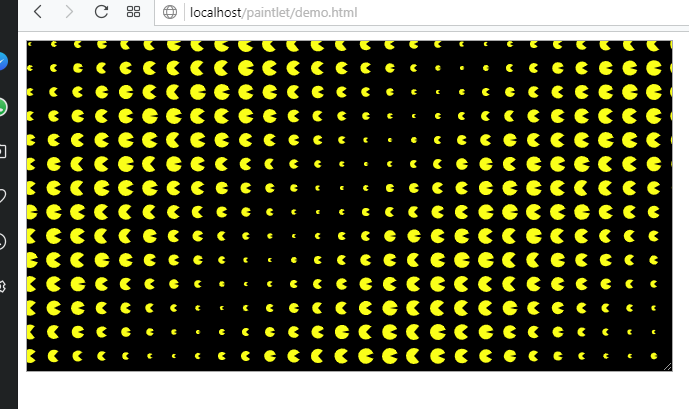
The image below is a rather silly example of what can be done with paintlets.
This effect was accomplished by adding a paint
module
to the paint worklet, and then, in its paint() method, drawing on
the supplied ctx as if it had been a canvas. It is also possible to
supply configuration from CSS to the script, something that can make
paintlets easier to use than other ways to generate background images.
<!-- demo.html -->
<style>
  textarea {
  background-image: paint(circlearcpainter);
  --circle-arc-pixel-size: 24;
  }
</style>
<!-- Textarea is a good demo since it can be resized. -->
<textarea></textarea>
<script>
  CSS.paintWorklet.addModule('circle_arc.js');
</script>
The module itself is defined with the javascript below.
// circle_arc.js
class CircleArcPainter {
    circle_arc(ctx, x, y, radius, angle) {
        let angleInRad = (angle * 0.9 / 2 + 10) * Math.PI / 180;
        ctx.fillStyle = 'yellow';
        ctx.beginPath();
        ctx.arc(x, y, radius,
                angleInRad, Math.PI * 2 - angleInRad, false);
        ctx.lineTo(x, y);
        ctx.closePath();
        ctx.fill();
    }
    static get inputProperties() { return ['--circle-arc-pixel-size']; }
    paint(ctx, geom, properties) {
        const css_prop = properties.get("--circle-arc-pixel-size");
        const size = css_prop ? parseInt(css_prop.toString()) : 100;
        ctx.fillStyle = "black";
        ctx.fillRect(0, 0, geom.width, geom.height);
        for (let x = 0; x < geom.width/size; x++) {
            for (let y = 0; y < geom.height/size; y++) {
                const circle_size = Math.abs(
                    Math.sin((x + y) / 6)) * size / 4 + size / 12;
                const opening = Math.random() * 90;
                this.circle_arc(ctx, (x + 0.5) * size, (y + 0.5) * size,
                                circle_size, opening);
            }
        }
    }
}

// Register our class under a specific name
registerPaint('circlearcpainter', CircleArcPainter);
Server Timing API
With the new Server Timing API
there is a well defined way for servers to pass performance
information to the browser through HTTP headers. With this information
web pages can make even better informed decisions.
In Developer Tools this information is displayed in the Network view
by selecting the resource and activating the Timing tab.
CSS
The
:any-link
pseudo selector can be used to style both visited and non-visited
links at the same time.
For colors, the rgb and hsl functions now take an optional
fourth alpha
value, making them identical to rgba and hsla.
display:
contents
allows an element to wrap other elements without creating a box for
itself.
DOM
There is now an
assignedElements()
on <slot> elements, which acts
like assignedNodes() but only returns element nodes.
A new feature policysync-xhr will allow a site to block synchronous
XMLHttpRequests. Synchronous XMLHttpRequests block scripts until a
server has responded which can make them harmful for the user
experience. If a site embeds untrusted, possibly malicious, content
(think ads), this adds a tool to lock that content down a bit.
Network
The HTTPS code is updated to match the draft-23
version of the
TLS protocol.
Request.destination
is added to give service workers a better understanding of why a
resource is fetched.
Performance APIs
A toJSON() method has been added to PerformanceResourceTiming,
PerformanceLongTaskTiming and TaskAttributionTiming.
Security
The download
attribute will be ignored on anchor elements with
cross-origin attributes.
Certificates from Symantec’s Legacy PKI issued after 2017-12-01 will
no longer be trusted. This will only affect sites that
selected to not transition to DigiCert’s new PKI. More information
can be found in the offical
announcement.
What’s next?
If you’re interested in experimenting with features that are in the
pipeline for future versions of Opera, we recommend following our
Opera Developer stream.
]]>https://dev.opera.com/blog/opera-51/What’s new in Chromium 64 and Opera 512018-02-07T00:00:00+00:002018-02-07T00:00:00+00:00Fredrik SöderqvistOpera 51 (based on Chromium 64) for Mac, Windows, Linux is out! To
find out what’s new for users, see our Desktop blog post.
Here’s what it means for web developers.
Mitigations for the “Spectre” vulnerability
In order to mitigate the
recently disclosed security vulnerability called “Spectre”, the following restrictions that affect the functionality
of the web platform have been applied:
The SharedArrayBuffer functionality has been removed.
The resolution of performance.now() has been clamped to 100μs.
Both of the above serve to reduce the possibility of performing a side-channel attack to read sensitive user data, by
removing potential ways to acquire a high-precision timing source.
Resize Observer
Responsive web applications are often written using CSS media queries or window.onresize to build components that
adapt to different viewport sizes. Both of these are global signals, thus requiring the overall viewport to change in
order for the site to respond accordingly. With the Resize Observer API, web
applications can observe changes to sizes of elements on a
page with finer granularity.
The following code snippet uses the Resize Observer API to observe size changes to an element:
  const ro = new ResizeObserver((entries) => {
    for (const entry of entries) {
      const cr = entry.contentRect;
      console.log('Element: ', entry.target);
      console.log(`Element size: ${cr.width}px × ${cr.height}px`);
      console.log(`Element padding: ${cr.top}px / ${cr.left}px`);
    }
  });

  // Observe one or multiple elements
  ro.observe(someElement);
import.meta
Developers writing JavaScript modules often want access to host-specific metadata about the
current module. To make this easier, support for the import.meta property has been added. This property currently exposes the module URL as import.meta.url. Authors of libraries may want to
access the URL of the module being bundled into the library to more easily resolve resources
relative to the module file as opposed to the current HTML document.
Other features in this release
Blink > Animation
The offset-path property can now be
animated, allowing for even more creative ways to move an element
around.
Blink > Fonts
The text-decoration-skip-ink CSS
property has been added, allowing developers better control over how underline
and overline decorations are drawn
when they cross over a glyph.
Support for Unicode property escapes\p{…}
and \P{…} for regular expressions that have the ‘u’ flag set has been added, allowing developers to create more
powerful Unicode-aware regular expressions.
The default preload value
for <video> and <audio> elements has been changed to metadata in order to reduce bandwidth and resource usage,
by only loading resource metadata and not the media resource itself. This aligns Opera with other browser
implementations.
A "NotSupportedError"DOMException is now thrown when
a media element’s playbackRate is set to a value
that is not supported
by Opera, like a negative value.
getUserMedia() now returns a rejected
Promise with a DOMException or OverconstrainedError when there is an error.
Blink > Network
The cache mode of a Request can now be specified using
the cache option and accessed using
Request.prototype.cache. For reload requests, the
"reload" value is now also exposed through said property.
HTMLElement.prototype.focus, accepts the
preventScroll option, to allow focusing an element without scrolling to it.
Blink > SVG
Support for the transform-box CSS property has
been added. This allow developers better control over what percentages are resolved against in the
transform and
transform-origin properties on SVG elements.
Blink > WebAudio
AudioWorklet, an API that
exposes low-level audio processing capability
to support custom AudioNodes, is now available behind the experimental flag.
Blink > WebRTC
The RTCPeerConnection interface now supports addTrack()
for single stream use cases, as well as removeTrack(), getSenders() and ontrack. A minimal version of the
RTCRtpSender interface is now also supported.
Blink > Window APIs
window.alert()no longer
brings a backgrounded tab to the foreground but instead shows the alert when the user switches to the background tab.
If you’re interested in experimenting with features that are in the
pipeline for future versions of Opera, we recommend following our
Opera Developer stream.
]]>https://dev.opera.com/blog/opera-50/What’s new in Chromium 63 and Opera 502018-01-04T00:00:00+00:002018-01-04T00:00:00+00:00Jens WidellOpera 50 (based on Chromium 63) for Mac, Windows, Linux is out! To
find out what’s new for users, see our
Desktop blog post.
Here’s what it means for web developers.
Dynamic module imports
New JavaScript module import syntax allows developers to dynamically load code
into modules and scripts at runtime. This makes it possible to load parts of an
application lazily, which can be used to improve application start-up time or to
avoid loading seldom used parts until they are actually needed.
Using the new
Device Memory API
developers can estimate the total amount of RAM on the device. This information
could be used to deliver a suitably scaled version of the site to lower-end
devices, or help put collected performance data into context to better
understand the behavior of a web application.
To improve interoperability, Opera will fire beforeprint and afterprint
events as part of the printing standard, allowing developers to annotate the
printed copy and edit the annotation after the printing command is done
executing.
Blink > JavaScript
Using
Promise.prototype.finally(),
a callback can now be registered to be invoked after a Promise has been
either fulfilled or rejected.
The
Intl.PluralRules API
allows developers to build applications that understand pluralization of a
given language by indicating which plural form applies for a given number and
language.
Version 2
of
NT LAN Manager (NTLM) API
is now shipped, enabling applications to authenticate remote users and provide
session security when requested by the application.
Blink > Storage
The
localStorage and sessionStorage APIs
now use getItem() rather than an anonymous getter, so attempting to access a
key using getItem() will now return null rather than undefined. Thanks
to Intel for the contribution!
To improve developer experience, the methods on
sessionStorage and localStorage
such as getItem(), removeItem(), and clear() are now enumerable. Thanks
to Intel for making this happen!
Deprecations and interoperability improvements
Blink > Bindings
To improve interoperability, a TypeError is now thrown by
EventTarget.addEventListener() and EventTarget.removeEventListener() when
the callback argument is not an EventListener, null, or undefined.
Also to improve interoperability,
instance properties
with a Promise type now return a rejected promise instead of throwing an
exception when the property access fails.
If you’re interested in experimenting with features that are in the
pipeline for future versions of Opera, we recommend following
our Opera Developer stream.
]]>https://dev.opera.com/blog/opera-49/What’s new in Chromium 62 and Opera 492017-11-08T00:00:00+00:002017-11-08T00:00:00+00:00Daniel BratellOpera 49 (based on Chromium 62) for Mac, Windows, Linux is out! To
find out what’s new for users, see our
Desktop blog post.
Here’s what it means for web developers.
Network Quality Estimator API
There are times when a web page want to adapt to the user’s network. To
help a web page with that information there is now the
Network Information API which can give a
rough indication of the user’s network, including bandwidth and round-trip time.
This is still under development but the parts that exist today, rtt,
effectiveType and downlink, should be enough for most use cases.
The plan is that these signals will also become available as HTTP request
headers and enabled via Client Hints.
OpenType Variable Fonts
Previously a font file could only contain one weight/variant of a font. So you
had one file for bold, one file for semi-bold, one for stretched, one
for normal and so on. With
OpenType Font Variations
you can combine those
variants efficiently in a single file. This should allow web pages to be smaller
and load faster than before, while also giving them access to an
infinite number of font variants (not that I recommend using more than a few
in a page).
It is now possible to stream animations directly from a canvas or
video element to anything that can handle a stream. Previously it was
only possible to stream from capture hardware on the computer.
Through the W3C Media Capture from DOM Elements API you can
call captureStream() on any HTMLMediaElement and send it to another
video element or stream it remotely through WebRTC. Or process or manipulate
it in other ways.
Other web platform features in this release
DOM interfaces are now supported for
<data>
and
<time>. We
used to have support for the time element but it has been missing for a
while. This gives web developers a standardized way to store
machine-readable data.
ECMAScript regular expressions have been expanded to support lookbehind assertions in addition to lookaheads. This can for instance be used to match a dollar price without capturing the dollar sign.
It is now possible to use the s flag to enable dotAll mode in ECMAScript regular expressions, making “.” match any character, including line terminators.
Loosened restrictions on escape sequences in ECMAScript template literals makes it possible to use template tags more. For instance for LaTeX processing.
The base language is now added immediately after language+region when generating accept-language headers from language settings to make it more likely users receive content in the language they expect.
To make web pages more responsive, transitional mouse events will now be dispatched and hover states updated more quickly after the layout has been modified. This will reduce the differences between different web browsers.
In line with other browsers, the getStreamById method on RTCPeerConnection has now been removed.
SharedWorker.workerStart has been removed, following its deprecation and removal from other major browsers.
To better conform to spec, the default value of <ol>.start has been set to 1.
What’s next?
If you’re interested in experimenting with features that are in the
pipeline for future versions of Opera, we recommend following our
Opera Developer stream.
]]>https://dev.opera.com/articles/introducing-ska-ssh-key-authority/Introducing SKA - SSH Key Authority2017-08-22T00:00:00+00:002017-08-22T00:00:00+00:00Krystian ZubelSKA is an open source access control system for SSH-based servers. It was originally created by
Opera Software and designed to provide scalable, secure and automated oversight on SSH public keys
access. SKA allows you to manage a user’s access to servers in a simple manner, no matter if it’s a
small amount of users and servers or hundreds of machines with a company’s LDAP connecting user
accounts. Some advantages include the ability to delegate authority over server access (defining who
has enough knowledge to approve access), its modern UI and no additional requirements apart from
proper SSH daemon configurations on managed servers.
At Opera, we have always preferred SSH Keys authentication method over weak passwords. However, as
we have had to oversee thousands of servers grouped in multiple services with SSH Keys distributed
among them, it turned out that there was no suitable solution on the market which met our needs.
Available systems either were not prepared to work in a flexible manner or required a lot of hassle
to distribute custom-built packages with authentication modules. That lead us to develop our own
solution.
Using flexible backend structures for synchronization, database and Web UI, we have created a system
that not only allows us to manage accesses but also to tune plenty of possible SSH hardening
settings per user. Diverse service specification (from servers using only server-to-server access
and to servers available for all users that are in our company LDAP) resulted in a very flexible
solution. Still, it has not lost it’s simple and responsive interface - because of the people who
work on this!
Today, after few years of using, fixing and expanding our system with more features, we would like
to allow everyone to use SKA - SSH Key Authority. No matter if you manage two or three servers or
you’re part of LDAP-based organization with thousands of users, SSH Key Authority can help you in
maintaining access and proper auditing of changes every day.
SKA is released under Apache License 2.0, and is
hosted on GitHub.
The system will continue to be developed and updated and we plan to add a few more features, such as
support for two-factor authentication with time-based tokens, in the near future.
Finally, a big kudos to the Opera IT Team for development and bug catching, and to all Opera
Employees for their extensive testing and feature requests!
]]>https://dev.opera.com/blog/opera-47/What’s new in Chromium 60 and Opera 472017-08-15T00:00:00+00:002017-08-15T00:00:00+00:00Fredrik SöderqvistOpera 47 (based on Chromium 60) for Mac, Windows, Linux is out! To
find out what’s new for users, see our
Desktop blog post.
Here’s what it means for web developers.
Paint Timing API
While no generalized metric perfectly captures when a page is loaded
in all cases, First Paint and First Contentful Paint are invaluable numbers to measure critical user moments during
loading. To give developers better insight
into their site’s loading performance, the new Paint Timing API
exposes metrics that capture First Paint and First Contentful Paint.
CSS font-display
Downloadable web fonts are often used to create more visually rich web experiences. Historically,
Opera has delayed rendering text until the specified font is available, to ensure visual
correctness. However, downloading a font can take as long as several seconds on a poor connection,
significantly delaying the time until a user sees content. Opera now supports the CSS font-displayproperty as part of an @font-face descriptor, allowing developers to specify how and when Opera displays text content while downloading fonts.
Credential Management API improvements
Starting in Opera 47, PasswordCredential also contains the user’s password, alleviating
the need for a custom fetch() to access a stored password.
Some changes has also been made to
to better align with the work being done in the Web Authentication Working Group.
This includes the deprecation of requireUserMediation, which has been renamed to preventSilentAccess.
Other features in this release
Object rest & spread properties are now supported, making it simpler to merge and shallow-clone objects and implement various immutable object patterns.
To improve performance and predictability, pointermove and mousemove events are now delivered once per animation frame (analog to requestAnimationFrame), matching the current functionality of scroll and TouchEvents.
The :focus-within CSS pseudo-class is now available, affectinganyelement the :focus pseudo-class affects, as well as any element with a descendant affected by :focus.
To provide an improved way to capture editing actions, InputEvent now allows user input to be managed by script, enhancing the details provided to editable elements.
To increase security, a beforeunload dialog triggered when the user leaves a site is now only shown if the frame attempting to display it has ever received a user gesture or user interaction, though the beforeunload event is still dispatched regardless.
VP9, an open and royalty-free video coding format, can now be used with the MP4 (ISO BMFF) container and requires the new VP9 string format mentioned below.
A new VP9 string format is now available and accepted by various media-related APIs, enabling developers to describe the encoding properties that are common in video codecs, but are not yet exposed.
Deprecations and interoperability improvements
getElementsByTagName() now accepts qualified names in response to an update to the DOM specification.
To improve the user experience, calls to Navigator.vibrate() now immediately return false if the user hasn’t explicitly tapped on the frame or any embedded frame, matching existing behavior for cross-origin iframes.
WEBKIT_KEYFRAME_RULE and WEBKIT_KEYFRAMES_RULE have been removed in favor of the unprefixed standardized APIs, KEYFRAME_RULE and KEYFRAMES_RULE.
Support for non-standard WebKitAnimationEvent and WebKitTransitionEvent has been removed from document.createEvent().
To better align with spec, NodeIterator.filter and TreeWalker.filter no longer wrap JavaScript objects, and .prototype has been removed from window.NodeFilter.
SVGPathElement.prototype.getPathSegAtLength() has been deprecated, and will be removed in Opera 49 (Chromium 62), since it has been been removed from the SVGPathElement interface in the SVG2 spec.
Headers.prototype.getAll() has been removed from the Fetch API in line with its removal from the spec.
What’s next?
If you’re interested in experimenting with features that are in the
pipeline for future versions of Opera, we recommend following our
Opera Developer stream.
]]>https://dev.opera.com/blog/opera-46/What’s new in Chromium 59 and Opera 462017-06-22T00:00:00+00:002017-06-22T00:00:00+00:00Simon PietersOpera 46 (based on Chromium 59) for Mac, Windows, Linux is out! To
find out what’s new for users, see our
Desktop blog post.
Here’s what it means for web developers.
Animated PNG
Opera now supports animated PNG, or APNG for short. APNG is a file format that works similarly to
GIF. The difference is that APNG is smaller and supports both 24-bit images and 8-bit transparency.
It has become quite popular recently, particularly since Apple adopted the APNG file format for
the iOS 10 iMessage apps.
APNG was also supported in Presto-based Opera 12.
This was actually added in Opera 44, but we missed to write about it!
This might still be a bit rough in the edges, but in general SVG favicons should now work in Opera!
(Not yet in Chromium.)
To see this in action, check some of the WHATWG standards which use SVG
favicons. Firefox also supports SVG favicons, and it was
also supported in Presto-based Opera 12.
Expensive background tab throttling
Opera now throttles expensive background tabs. This reduces the processing power required for
background tabs and improves battery life and browsing performance. Try it out yourself with this
background timer throttling demo.
As a web developer, you also can help with reducing the work that your page or app does while being
in a background tab by using
requestAnimationFrame
instead of timers to drive animations, and the
Page Visibility API to stop
unnecessary work when the page is hidden.
Developers can now use MediaError’s message property to obtain greater detail about a MediaError produced by <audio> or <video>.
WritableStreams are now available as part of the Streams API for processing streams of data, while providing a standard abstraction for writing streaming data to a sink with built-in backpressure and queuing.
The Image Capture API now allows sites to take higher resolution images than before, providing full control over camera settings such as zoom, ISO, and white balance.
To provide enhanced privacy, CSS stylesheets can now specify their own referrer policy via the HTTP header, rather than always inheriting the referrer policy of the document that originally referenced it.
Touch events are now aligned to requestAnimationFrame, ensuring that input is processed as part of the document lifecycle and creating a more efficient and adaptive input response.
The <dialog> element has changed from display: inline to block by default to better align with the spec.
Following removal from the Media Queries spec, support for hover: on-demand and any-hover: on-demand media queries have been removed.
To better align with spec and help avoid race conditions, decodeAudioData now detaches the given ArrayBuffer before decoding, removing all content from the object and making it unable to be reused or examined.
The -internal-media-controls-cast-button CSS selector has been removed in favor of the Remote Playback API.
The -internal-media-controls-text-track-list* CSS selectors have been removed in favor of custom-built video controls.
The SVGTests.requiredFeatures attribute has been removed following its removal from the spec.
initDeviceMotionEvent() and initDeviceOrientationEvent() were removed in favor of DeviceOrientationEvent() and DeviceMotionEvent(), following a spec trend of moving away from initialization functions and toward constructors.
To preserve consistency across browsers, the sample property will now be included in a violation report (and associated SecurityPolicyViolationEvent object) if a report-sample expression is present in the violated directive.
To increase security, Opera will now block requests for subresources that contain embedded credentials, and instead handle them as network errors.
To increase security, Opera will now block requests from HTTP/HTTPS documents to ftp: URLs.
To preserve consistency across browsers, injecting JavaScript via AppleScript is longer supported in Opera for Mac.
The ability to call Notification.requestPermission() from non-main frames has been deprecated to align the requirements for notification permission with requirements for push notifications, and ease friction for developers.
Support for Shared Dictionary Compression (SDCH) has been disabled until a stable API has been standardized.
What’s next?
If you’re interested in experimenting with features that are in the
pipeline for future versions of Opera, we recommend following our
Opera Developer stream.
]]>https://dev.opera.com/blog/opera-45/What’s new in Chromium 58 and Opera 452017-05-10T00:00:00+00:002017-05-10T00:00:00+00:00Karl Anders ØygardOpera 45 (based on Chromium 58) for Mac, Windows,
Linux is out! To find out what’s new
for users, see our Desktop
blog. Here’s what it means for web developers.
IndexedDB 2.0
IndexedDB 2.0 is now supported in
Opera, making it simpler to work with large data sets in the
browser. IDB 2.0 features new schema management, bulk action methods,
and more standardized handling of failures.
The structure of a site’s database has large performance impacts and
can be difficult to change. To simplify updates, object
stores and
indexes can now be
renamed in-place after a refactoring. Sites can also use more natural
keys without worrying about a performance penalty thanks to binary
keys, which allow
compact representations for custom keys.
For more information about what IndexedDB 2.0 brings, check out
Bevis Tseng’s
summary.
An improvement to iframe navigation
Third-party content, such as advertising, that automatically redirects
the page can annoy users and create security issues. Because of this,
developers are able to put third-party content inside sandboxed
iframes to prevent this behavior. However, in some cases this type of
content needs to navigate the top-level page when clicked, like a
standard advertisement.
To address this, Opera 45 now supports the new iframe sandbox
keyword
allow-top-navigation-by-user-activation. This
keyword gives sandboxed iframes the ability to navigate the
top-level page when triggered by user interaction, while still
blocking auto-redirects.
Selection API changes
Using removeRange(), a new function, developers can now programmatically remove a specified text Range.
When accessing properties like selectionDirection, selectionStart, and selectionEnd, Opera will now return null when it would have thrown an InvalidStateError DOMException.
Rather than silently clamping offset values that were too large, setBaseAndExtent() now throws an IndexSizeError DOMException to better align with spec.
Rather than silently failing for DocumentType node inputs, setBaseAndExtent(), extend(), and collapse() now throw InvalidNodeTypeError DOMException to better align with spec.
To improve interoperability, Selection.addRange() now ignores an additional range if it overlaps with an existing range, rather than merging the two ranges.
To better align with spec, getRangeAt() now always returns a new Range with position normalization.
Other features in this release
Opera adds in-form warnings for sensitive fields when the top-level page is not HTTPS. Whenever you start filling in your password or credit card number on a page, which is not HTTPS, the warning will appear.
PointerEvents.getCoalescedEvents() allows developers to access all input events since the last time a PointerEvent was delivered, making it easier for drawing apps to create smoother curves using a precise history of points.
Developers can now customize Opera’s native media controls such as the download, fullscreen and remoteplayback buttons using the new ControlsList API.
Sites can now access the approximate range of colors supported by Opera and output devices using the color-gamut Media Query.
To simplify developer experience, trailing commas are now allowed in JavaScript for formal parameter and argument lists.
The WebAudio API’s new playback AudioContextLatencyCategory enables the developer to easily make conscious tradeoffs between latency, power, and CPU efficiency.
Deprecated and removed features
Apple-interchange-newline, Apple-converted-space, Apple-paste-as-quotation, Apple-style-span, and Apple-tab-span have been deprecated as they are non-standard CSS classes.
usemap attributes now use case-sensitive matching rather than compatibility caseless to better align with spec.
Sites must now use HTTPS when requesting notification permissions or creating non-persistent local notifications with the Notifications API, in accordance with Chromium’s policy around powerful features.
Encrypted Media Extensions transmitted over non-secure origins has been deprecated per Chromium’s policy around powerful features and in compliance with the spec.
To better align with spec, cancelBubble is now considered an alias to stopPropagation() when set to true, and does not do anything when set to false.
The VTTRegion interface functions, addRegion() and removeRegion(), have been removed from the WebVTT spec and are therefore being removed from Opera.
Top-level navigations to data: URLs have been deprecated to further protect users from spoofing and phishing attempts.
An instance of HTMLEmbedElement or HTMLObjectElement can no longer be called as a function, since the legacy caller has been removed.
Pre-standard ChaCha20-Poly1305 ciphers have been removed following the standardization of these algorithms at the IETF as RFC 7539 and RFC 7905, and the subsequent shipping of the standard versions in Opera 28.
The AudioBuffer constructor now accepts the sampleRate member of an AudioBufferOptions dictionary instead of a context argument, simplifying the interface and emphasizing that AudioBuffers can be shared between AudioContexts.
The synchronous FileReaderSync API has been deprecated in service workers, as the service worker spec requires all types of synchronous requests to be initiated outside of a service worker.
The abbr and acronym elements now have a dotted underline by default to align with the HTML standard.
The motion-path, motion-offset, and motion-rotation CSS properties have been removed in favor of the new versions: offset-path, offset-distance, offset-rotate.
The AudioSourceNode interface has been removed as it was not part of the WebAudio spec.
The webkitdropzone attribute has been removed as it was not widely adopted.
What’s next?
If you’re interested in experimenting with features that are in the
pipeline for future versions of Opera, we recommend following our
Opera Developer stream.
]]>https://dev.opera.com/blog/opera-44/What’s new in Chromium 57 and Opera 442017-03-22T00:00:00+00:002017-03-22T00:00:00+00:00Simon PietersOpera 44 (based on Chromium 57) for Mac, Windows, Linux is out! To find out what’s new for users, see our Desktop blog. Here’s what it means for web developers.
CSS Grid
CSS Grid is now available. CSS Grid supports a two-dimensional grid-based layout system, optimized
for responsive user interface design. Elements within the grid can be specified to span multiple
columns or rows. Elements positioned in a CSS grid can also be named, making layout code easier to
understand. There are lots of excellent resources available to learn more:
Learn CSS Grid — an awesome compilation of resources by Jen Simmons.
The WebAssembly API has been enabled by default, allowing developers to run near-native code in the
browser without a plugin. WebAssembly is essentially a better replacement for
asm.js. We believe it has the potential to bring browser
games to the next level.
Opera 44 also adds support for the Credential Management
API. This gives
users a simpler sign-in process across devices and provides websites with more control over the
usage of credentials. The website can use password-based sign-ins via this API. Once logged in,
users will be automatically signed back into a site, even if their session has expired.
Other CSS features
The caret-color property enables developers to specify the color of the text input cursor.
text-decoration-skip: ink can be used to make underlines skip descenders, the portion of letters that extend below the text’s baseline.
New text-decoration properties are now available, allowing developers to specify visual effects such as line color and style.
Audio/video
The new AudioContext.getOutputTimestamp() method enables developers to synchronize DOMHighResTimeStamp and AudioContext.currentTime values.
AudioBufferSourceNode, OscillatorNode, and ConstantSourceNode now inherit from AudioScheduledSourceNode, consolidating functionality.
The new cancelAndHoldAtTime function cancels future AudioParam events with times greater than or equal to cancelTime, allowing developers to preserve the value of the scheduled time in a direct way.
The new padStart and padEnd formatting tools enable text padding, facilitating tasks like aligning console output or printing numbers with a fixed number of digits.
To preserve consistency with other on<event> attributes, ongotpointercapture and onlostpointercapture are now part of the GlobalEventHandlers mixin.
Support for the <keygen> element has been removed, causing it to no longer display any controls nor submit form element data, to align with other browsers.
Locally-trusted SHA-1 certificates will now result in a certificate error page.
The <cursor> element has been removed, but cursor icons can still be set via the cursor CSS property.
A legacy caller has been removed from HTMLEmbedElement and HTMLObjectElement, so the interfaces will now throw exceptions rather than having their instances called as functions.
All webkit-prefixed IndexedDB global aliases have been removed, after their deprecation in M38 (Opera 25).
Support for webkitClearResourceTimings(), webkitSetResourceTimingBufferSize(), and onwebkitresourcetimingbufferfull has been removed from the Performance interface, in favor of clearResourceTimings(), setResourceTimingBufferSize(), and onresourcetimingbufferfull.
The -internal-media-controls-text-track-list* and related pseudo-elements are deprecated and will be removed in M59 (Opera 46). Use custom controls for custom text track selection.
Support for the obsolete API webkitCancelRequestAnimationFrame has been removed in favor of cancelAnimationFrame.
The webkit prefix has been removed from AudioContext and OfflineAudioContext.
What’s next?
If you’re interested in experimenting with features that are in the pipeline for future versions of Opera, we recommend following our Opera Developer stream.
]]>https://dev.opera.com/blog/opera-43/What’s new in Chromium 56 and Opera 432017-02-07T00:00:00+00:002017-02-07T00:00:00+00:00Simon PietersOpera 43 (based on Chromium 56) for Mac, Windows, Linux is out! To find out what’s new for users, see our Desktop blog. Here’s what it means for web developers.
Prerender from address bar
Opera will now prerender pages that are typed into the address bar, before the user hits enter,
which can make the page finish loading much sooner.
If you can predict what the user’s likely next navigation will be, you can start a prerender from
the current page by using <link rel=prerender>.
This has actually been supported since Opera 15, but this seemed like a good opportunity for a
reminder. 🙂 For more information about how to use prerender and other resource hints, see
Resource Hints – What is Preload, Prefetch, and Preconnect?
by Brian Jackson.
Classic link selection
Opera now allows users to select link text instead of always dragging the link (like in Opera 12).
The user can select by dragging left or right, and start a drag-and-drop by dragging up or down.
Not being able to select text to copy and paste is often frustrating for users. But in some cases it
can be justified, like if a link is being used to act as a button, or if text is used only for
decoration. To disable text selection in general, CSS user-select: none
can be used.
Scroll anchoring intervention
When some content changes above the viewport (e.g., an image is loaded), what used to happen is that
the rest of the content is pushed down. With the scroll anchoring
intervention the scroll position is updated to keep the content currently in the viewport stable.
This behavior can be disabled for a specific subtree or for the whole page by using CSS overflow-anchor: none.
See this video for a comparison with and without this
intervention.
CSS
Opera now supports position: sticky,
a new way to position elements. A position: sticky element is relatively-positioned, but becomes
position: fixed after the user reaches a certain scroll position. This results in smoother scroll
without jumps compared to trying to achieve the same thing with scroll events and JavaScript.
For more info see this article
by Paul Kinlan.
The new generic font familysystem-ui
is now supported, which matches the platform’s default UI font.
Non-whitespace Unicode control characters will now be rendered according to the
specification, rather than being ignored.
HTTP Referrer-Policy header
The new Referrer-Policy
HTTP header allows sites to forward site traffic by URL without leaking the user’s session identifier
or other private information.
Events: keyboardEvent.isComposing
The KeyboardEvent interface now supports the
isComposing attribute
which returns true if this event is fired between compositionstart and compositionend events.
ConstantSourceNode is a new audio source node that produces a constant output mixed with an AudioParam.
Two Web Audio ChannelSplitterNode interface attributes are now read-only: channelCount, which is defined by numberOfOutputs in createChannelSplitter(), and channelCountMode, which is set to explicit.
PannerNode.rolloffFactor now clamps to the nominal range of a PannerNode’s distance model to describe the volume reduction rate as the source moves away from the listener.
Support for FLAC is enabled within the FLAC and Ogg containers for the audio HTML element and decodeAudioData().
Shadow DOM’s slotchange events bubble, but no longer re-fires, at a slot’s assignedSlot.
Deprecated and removed features
Non-script MIME types for external scripts (e.g., <script src="foo" type="something/something">) was deprecated (generated a message in the console) in Opera 42 and now in Opera 43 are no longer pre-fetched. This typically results in less wasted fetches. <script data-src="foo" type="something/something"> is recommended instead.
The Web Audio API no longer includes the deprecated Doppler API, including speedOfSound, dopplerFactor, and setVelocity.
RTCPeerConnection now accepts iceTransportPolicy as an RTCConfiguration parameter as well as iceTransports.
RTCPeerConnection is now available without a webkit prefix, though webkitRTCPeerConnection still remains.
The reflected-xss directive has been removed from Content Security Policy 2 since it was solely a wrapper for the X-XSS-Protection header and provided no additional functionality.
Support for the MediaStreamTrack.getSources() method has been removed in favor of MediaDevices.enumerateDevices().
The CSP referrer directive is no longer supported in favor of the new Referrer-Policy header mentioned above.
Legacy CBC-mode ECDSA cipher suites ECDHE_ECDSA_WITH_AES_128_CBC_SHA and ECDHE_ECDSA_WITH_AES_256_CBC_SHA have been removed in favor of modern ciphers such as ECDHE_ECDSA_WITH_AES_128_GCM_SHA256.
ECDSA with both SHA-1 and SHA-512 have been removed to reduce dependencies on SHA-1 and align with TLS 1.3’s new ECDSA handling.
MIDIMessageEvent.receivedTime has been deprecated in favor of Event.timeStamp, since Event.timeStamp now supports high-resolution monotonic time instead of epoch time.
What’s next?
If you’re interested in experimenting with features that are in the pipeline for future versions of Opera, we recommend following our Opera Developer stream.
]]>https://dev.opera.com/blog/opera-42/What’s new in Chromium 55 and Opera 422016-12-14T00:00:00+00:002016-12-14T00:00:00+00:00Simon PietersOpera 42 (based on Chromium 55) for Mac, Windows, Linux is out! To find out what’s new for users, see our Desktop blog. Here’s what it means for web developers.
Built-in currency converter
Opera is now the first of the major browsers to add a built-in currency converter.
The user select the price they want to convert on the page and Opera will automatically show it in their local currency. Opera 42 supports conversion in 32 currencies based on daily values from the European Central Bank.
Currency symbols are supported, but for ambiguous symbols (e.g. “$”, “kr”) we recommend using the ISO 4217 alphabetic code before or after the amount, as selectable text. This makes it unambiguous for Opera’s currency converter what to convert from, but it should also be helpful for end users and other tools in general.
<p>USD 50</p>
<p>995 SEK</p>
Input handling improvements
The PointerEvent standard is now supported. It gives developers a unified API for handling “pointer” user input, whether that is mouse, touch, pen, etc. PointerEvent also does not block scrolling, which should reduce jank during scrolling. When using TouchEvent, the same performance benefit can be achieved using passive event listeners. The touch-action CSS property is now also supported, to allow reacting to gestures such as panning. For more information, see Pointing the Way Forward by Sérgio Gomes.
The auxclick event is now fired for non-primary mouse buttons, instead of click.
JavaScript async and await
The async and await keywords are now supported, which allows writing Promise-based JavaScript with a neater syntax, and enables use of try/catch to catch rejected promises.
The hyphens CSS property is now supported (on Mac), which can be used to enable automatic hyphenation when text is broken across multiple lines. Possible values are none, manual (initial value) and auto.
For none, hyphenation will not happen even when ­ is used. For manual, hyphenation only happens for ­. For auto, automatic hyphenation happens, based on the language specified in the lang attribute.
The TLS stack now implements GREASE, a mechanism to help prevent problems with buggy TLS servers.
RSA-PSS signature algorithms have been added to TLS to prepare for TLS 1.3.
New constructors
new MediaStreamTrackEvent(type, options) and new AudioNode(context, options) constructors are now available.
document.write() intervention
Cross-origin and parser-blocking scripts injected using document.write() will no longer load over 2G connections. See this article by Paul Kinlan for more information.
Deprecated and removed features
As mentioned above, the click event is no longer fired for non-primary mouse buttons. In most cases this is desirable; click event handlers are most often intended to handle primary clicks. But if you need to handle non-primary clicks (e.g., middle mouse button), the auxclick event can be used. The contextmenu event can also be used to handle clicks that would open a context menu (typically right-click).
BaseAudioContext will replace AudioContext in the Web Audio API.
CSS Clipping Path properties no longer require the webkit prefix.
The MediaStream constructor is now available without prefix alongside the existing webkitMediaStream.
Non-script MIME types for external scripts (e.g., <script src="foo" type="something/something">) is deprecated and will from M56 (Opera 43) no longer be pre-fetched. This typically results in less wasted fetches. <script data-src="foo" type="something/something"> is recommended instead.
<textarea maxlength=""> and <textarea minlength=""> have been updated to count each line break as one character, instead of two.
The webkit prefix has been removed from the imageSmoothingEnabled property of CanvasRenderingContext2D.
What’s next?
If you’re interested in experimenting with features that are in the pipeline for future versions of Opera, we recommend following our Opera Developer stream.
]]>https://dev.opera.com/articles/pwa-resources/Progressive Web Apps: The definitive collection of resources2016-11-11T00:00:00+00:002016-11-11T00:00:00+00:00Bruce Lawson, Shwetank DixitIntroduction
Want to get started with progressive web apps, but not sure where to start? This page will list the best resources we know of to help you understand Progressive Web Apps (PWAs), get started and learn things in depth.
Make sure to bookmark this page, as this is a living document that we’ll be adding to from time to time.
Progressive Web Apps: The what, how and why
These articles introduce the concept of Progressive Web apps and serve as a jumping point to learn more about them.
Progressive Web Apps: An interview with PWA expert, Henrik Joreteg, who’s been working with his clients to architect, build and train teams on building performant mobile web apps.
UI Concepts
One of the best things about PWAs are that they can be added to the home screen of your Android device, just like native apps can. This section contains relevant articles covering the ‘Add to Home Screen’ capability, as well as a few articles on how to make your web app UI running smoothly.
Progressive Web Apps are capable of running offline just like native apps. This is primarily through a feature called ‘Service Worker’. Service Workers are great, and besides being used to make web apps run offline, are also required for other functionality like Push Notifications and Background Sync.
Service Workers: An Introduction: A great intro by the Google Team on what you need to know to get started with Service Workers.
The Offline Cookbook: Jake Archibald covers a variety of use cases for offline functionality along with helpful illustrations and code examples for the service wokers code. Very well worth a look!
Service Worker: Santa’s Little Performance Helper: Phil Nash covers Service Worker through a practical example. Its also contains a great example of caching web fonts for offline use using Service Workers.
Using Service Workers: The Mozilla team’s introduction to Service Workers on MDN. It contains some useful infographics on various parts of the Service Worker lifecycle, and more.
Making a Service Worker: A fantastic article by Lyza Danger Gardner going in-depth with Service Workers.
serviceworke.rs: Mozilla’s site detailing various caching strategies and use cases along with code examples.
Designing Offline-first Web Apps: Besides giving helpful tips on good offline experiences, this article helps you think differently about offline as a user state in the first place.
Push notifications are helpful in notifying the user of important, relevant or timely events, even if your site isn’t open in the browser, or even when the browser is closed. With the Push API spec and Service Workers, you can finally implement this in your progressive web app too. Be careful not to spam your users!
Web Starter Kit: A boilerplate for web development including sw-toolbox and sw-precache libraries.
Fetch-sync: Fetch Sync allows you to proxy fetch requests through the Background Sync API so that they are honoured if made when the UA is offline.
Msgr: Nifty service worker/client message utility.
Showcases, case studies and more
Take a look at what others are doing with Progressive Web Apps. Get inspiration and see how it has benefitted others in key business metrics.
PWA.Rocks: The showcase for the best Progressive Web Apps in the world. It’s maintained by the Opera Developer Relations team, and we accept Pull Requests if you have a great-looking responsive PWA. Remember, sites aren’t “mobile-only” so the best PWAs look great on desktop and devices.
Google PWA Showcase: Google’s showcase of companies which have befitted from PWAs.
PWAs: An African Perspective: We interview two great developers from Nigeria and Kenya about PWAs. Read their thoughts on how PWAs can help solve problems in that region.
Books
Books to help you learn about PWAs.
Progressive Web Apps: This book teaches you PWA design and the skills you need to build fast, reliable websites by taking you step-by-step through real world examples.
]]>https://dev.opera.com/blog/opera-41/What’s new in Chromium 54 and Opera 412016-10-25T00:00:00+00:002016-10-25T00:00:00+00:00Mathias BynensOpera 41 (based on Chromium 54) for Mac, Windows, Linux is out! To find out what’s new for users, see our Desktop blog. Here’s what it means for web developers.
Web Components: Custom Elements v1
Custom elements form the foundation of web components. The initial version of the API, also known as Custom Elements v0, has been supported since Opera 20 & Chrome 33. With the v0 API, a new custom element was defined using document.registerElement().
Since then, the spec has been updated based on web developer and browser vendor feedback. The improved API is called Custom Elements v1. The new hip & trendy way of defining a custom element is through customElements.define(). The v0 API is now deprecated and will be removed in a future release.
The BroadcastChannel API allows same-origin scripts to send messages to other browsing contexts. It can be thought of as a simple message bus that allows publish-subscribe semantics between windows, tabs, iframes, web workers, and service workers. Think of it as a simpler, same-origin version of the good ol’ postMessage() API.
The full set of CacheQueryOptions is now supported, making it easier to find the cached responses you’re looking for. Here’s the complete list of available options:
You can now use user-select instead of -webkit-user-select in CSS. The user-select property makes it possible to specify which elements in the document can be selected by the user and how.
Navigations in unload handlers now blocked
Navigations initiated in an unload handler are now blocked. Instead, any prior navigation will continue. This matches the behavior in Firefox, and matches Edge’s behavior more closely than before.
CECPQ1 is a post-quantum cipher suite: one that is designed to provide confidentiality even against an attacker who possesses a large quantum computer. It is a key-agreement algorithm plugged into TLS that combines X25519 and NewHope, a ring-learning-with-errors primitive. Even if NewHope turns out to be breakable, the X25519 key-agreement will ensure that it provides at least the security of our existing connections.
Note that this is only an experiment. In fact, the plan is to discontinue this experiment within two years, hopefully by replacing it with something better. See “Experimenting with post-quantum cryptography” for more details.
Deprecated and removed features
URL.createObjectURL and URL.revokeObjectURL are now deprecated in service worker contexts.
Similarly, the File API spec once removed the FileError interface. It has been deprecated since 2013. Any usage of FileError triggered a warning in the DevTools console since Opera 40 & Chromium 53. As of this release, FileError is no longer supported.
To more closely match other browser’s behavior, window.external.IsSearchProviderInstalled and window.external.AddSearchProvider (originally intended to add search engines programmatically) are now both no-ops. This functionality was never implemented in Safari. In IE10, these methods are (mostly) no-ops: IsSearchProviderInstalled always returns 2, and AddSearchProvider always returns S_OK. Firefox still implements this, but notes that it may be removed at any time.
If you’re interested in experimenting with features that are in the pipeline for future versions of Opera, we recommend following our Opera Developer stream.
]]>https://dev.opera.com/blog/opera-40/What’s new in Chromium 53 and Opera 402016-09-20T00:00:00+00:002016-09-20T00:00:00+00:00Mathias BynensOpera 40 (based on Chromium 53) for Mac, Windows, Linux is out! To find out what’s new for users, see our Desktop blog. Here’s what it means for web developers.
Improved <input pattern="…">
The u flag (which stands for Unicode) is now applied to any regular expressions compiled through the pattern attribute for <input> and <textarea> elements.
This enables more Unicode-friendly features, and generally more sensible behavior.
<input pattern="[🍪🎂🍩]">
<!--
	The input only validates when it is either 🍪, 🎂, or 🍩.
	(Previously, those strings would fail validation.)
-->
The Presentation API defines the nw allow-presentation sandboxing flag for <iframe sandbox="…"> which gives web developers control over whether an iframe can start a presentation session. By default, the Presentation API is disabled in sandboxed <iframe>s.
Shadow DOM v1
All browser vendors finally agreed on the Shadow DOM spec, called v1. The new Shadow DOM APIs include:
Chromium already supported -webkit-user-select, the prefixed version of user-select, but it didn’t recognize every value the spec defines. As of this update, the -webkit-user-select: all is supported. This property/value pair makes it so that if a selection would contain only part of an element, then the selection must contain the entire element including all its descendants.
For example, if you apply this on all <p> elements, and you then try to select a single word in a paragraph, the entire paragraph is selected automatically.
Generally, all content is re-rastered when its transform scale changes, unless will-change: transform is applied to it. In other words, will-change: transform effectively means “please apply the transformation quickly, without taking the additional time for rasterization”. This only applies to scaling that happens via JavaScript manipulation, and does not apply to CSS animations. For more information, see the technical summary for this change. A demo is available.
Deprecated and removed features
Synthetic events (i.e. those who are created by JavaScript, and are thus untrusted) are now prevented from executing their default action. click is the only exception for backwards compatibility with legacy content. This change matches the spec and other browsers.
The HTML spec was changed so that <label> elements aren’t form-associated elements anymore. As a result, support for the form attribute on <label> elements was removed, and labelElement.form is now an alias for labelElement.control.form (instead of mapping to the form attribute value).
HTTP/0.9, the predecessor to HTTP/1.x, is now deprecated, and will be removed in a future release. Its replacement, HTTP/1.0, was standardized 20 years ago.
Support for DHE-based TLS ciphers has been removed, after being deprecated in Chromium 51 & Opera 38. Servers should upgrade to ECDHE ciphers instead.
A long time ago, the File API spec was changed to remove the FileError interface. It has been deprecated since 2013. As we’re preparing to remove this interface entirely in a future release, any usage of FileError now triggers a warning in the DevTools console.
The TextEncoder API no longer accepts an argument that specifies the encoding. Instead, it always uses UTF-8. If an argument is passed, it is ignored. This means that new TextEncoder('utf-16') and new TextEncoder('utf-16be') no longer work.
What’s next?
If you’re interested in experimenting with features that are in the pipeline for future versions of Opera, we recommend following our Opera Developer stream.
]]>https://dev.opera.com/blog/opera-39/What’s new in Chromium 52 and Opera 392016-08-02T00:00:00+00:002016-08-02T00:00:00+00:00Mathias BynensOpera 39 (based on Chromium 52) for Mac, Windows, Linux is out! To find out what’s new for users, see our Desktop blog. Here’s what it means for web developers.
ES2016 exponentiation operator
ES2016 introduces an arithmetic operator equivalent of Math.pow(base, exponent), in which the lefthand-side expression serves as the base value, and the righthand-side expression serves as the exponent.
4 ** 3;
// → 64

let value = 4;
value **= 3;
value;
// → 64
Fetch API: Response construction with ReadableStream
It’s now possible to construct your own ReadableStream instances and to use them as bodies for Response objects, including from within service workers. This functionality is part of the Fetch standard. See Jeff Posnick’s write-up for details, or Jake Archibald’s in-depth blog post on streams for even more info.
Fetch API: referrer policy
Requests made using the Fetch API can use a specific referrer policy, which affects the value of the Referer HTTP header that’s sent to remote servers. This can be done by adding a referrerPolicy property to the options object passed to fetch, which accepts the following values:
CanvasRenderingContext2D instances now support the filter property that applies effects to primitives drawn to the canvas. The filter value is parsed in the same way as CSS filters.
An ImageBitmapOptions object is an options object that can be passed to createImageBitmap().
createImageBitmap(image, options).then(function(response) {
	// Do something with the `response`…
});
The available options are:
colorSpaceConversion indicates whether the image is decoded using color space conversion. Either 'none' or 'default' (default). The value 'default' indicates that implementation-specific behavior is used.
imageOrientation indicates whether the image is presented as-is or flipped vertically. Either 'flipY' or 'none' (default).
premultiplyAlpha indicates that the bitmap color channels are premultiplied by the alpha channel. One of 'none', 'premultiply', or 'default' (default).
resizeWidth indicates the new width.
resizeHeight indicates the new height.
resizeQuality specifies an image scaling algorithm. One of 'pixelated', high', 'medium', or 'low' (default).
Invalid <track kind> values are no longer treated as subtitles
Invalid values for <track kind> were previously treated as 'subtitles'. This means that any new values would be treated as subtitles by old browsers. Chromium now uses 'metadata' instead as the “invalid value default”, to avoid browsers showing <track>s with unrecognized values.
HTMLMediaElement.prototype.srcObject
The srcObject property on HTMLMediaElement instances enables associating a MediaStream to a media element using a simple assignment. Previously, achieving this required first obtaining a URL associated to the MediaStream, and then associating this URL to the media element.
Currently, only MediaStream objects are accepted because it is the only type currently supported by other major browsers, but Chromium aims to support more types in the future. (Per the spec, a MediaProvider can be a MediaStream, a MediaSource, or a Blob.)
Web Audio updates
AudioParam instances now have readonly minValue and maxValue properties that specify the minimum and maximum values the AudioParam can have. The value is clamped to lie in this range
Automation methods for the position and orientation coordinates of PannerNode and the position{X,Y,Z}, up{X,Y,Z}, and forward{X,Y,Z} vectors of AudioListener are now available. This allows smooth changes in the coordinates using AudioParam methods.
Chromium now implements the reduction property on DynamicsCompressorNode instances as a readonly float, matching the spec. Previously, the value was represented as an AudioParam.
RTCCertificates are self-signed certificates used in the DTLS handshake when setting up a connection with an RTCPeerConnection. Chromium now allows web applications to store RTCCertificates by implementing the structured clone algorithm. This means RTCCertificates can be saved and loaded from an IndexedDB database, saving the cost of generating new certificates for new sessions.
Performance Observer
The Performance Observer API is essentially a streaming interface that can be used to gather low-level timing information asynchronously, as it’s gathered by the browser. Marc Cohen’s write-up does a great job explaining it.
Pause event loop during modal dialogs
When using alert(), confirm() or onbeforeunload, Chromium’s old behavior was to block JavaScript while waiting for the result, but to allow all declarative animations to continue. As of this update, Chromium makes all main-thread tasks (such as <marquee> and CSS 2D animations) also pause during this interval.
Here’s a demo showing the impact of alert() on a CSS 2D animation.
CSS containment
The CSS contain property indicates that an element and its contents are, as much as possible, independent of the rest of the document tree. This allows the browser to recalculate layout (contain: layout), style (contain: style), paint (contain: paint), size (contain: size), or any combination of them for a limited area of the DOM and not the entire page. For more details, check out Paul Lewis’ explanation.
Previously, there was no way to completely disable the browser’s default rendering of <meter> elements and to restyle them using CSS. As of Chrome 52 / Opera 39, this finally became possible using -webkit-appearance: none.
New CSS Flexbox behavior for absolutely-positioned children
Alternative Services allow an origin serving an http:// or https:// resource to nominate additional origins that the client can choose to request the resource from instead when making subsequent requests. This can be used, for example, as a protocol upgrade mechanism, for connection pooling, or for load balancing.
This is done through the Alt-Used HTTP header.
For example, if the resource at https://origin.example.com/foo returns the following response headers:
Alt-Used: https://alternate.example.net
…and https://origin.example.com/bar is requested afterwards, then the browser may fetch either https://origin.example.com/bar or https://alternate.example.net/bar.
X-Frame-Options is now ignored when present inside a <meta> tag, e.g. <meta http-equiv="X-Frame-Options" contents="DENY">, matching the spec. Use an HTTP header (X-Frame-Options: DENY) instead.
A non-standard and little-used variant of the postMessage() API is being deprecated, specifically postMessage(message, transferables, targetOrigin). Use postMessage(message, targetOrigin, transferables) instead.
The ended event & property and the onended event handler have been removed from the Media Capture and Streams spec and are now being deprecated in Chromium.
What’s next?
If you’re interested in experimenting with features that are in the pipeline for future versions of Opera, we recommend following our Opera Developer stream.
]]>https://dev.opera.com/articles/pwa-desktop/Progressive web apps running as native OS X apps2016-07-26T00:00:00+00:002016-07-26T00:00:00+00:00Vlad FilippovProgressive Web Apps are getting ready for desktop
If you follow the Progressive Web App scene you’ve probably already seen multiple examples of the Air Horner app in mobile browsers such as Opera Mobile and Chrome for Android. However it is not easy to get your favorite PWA (such as Air Horner) to be a primary citizen on your favorite desktop operating system.
Browser makers are working on getting better support for PWAs in desktop, but it’s not quite ready yet. This is why I started the PWAify project. This project is powered by Node.js and Electron, which already have a huge community and provide ease of use for new and experienced developers. The PWAify project is still in the early experimental stages — use it at your own risk.
The goal of the PWAify project is to provide a solution for PWAs on desktop while we wait for browsers to develop support. In addition this project allows developers to experiment, give better feedback to browser makers, and improve the Web App Manifest specification.
What the installed Air Horner app looks like on Android and OS X
Currently the simplest use case is to just provide an HTTPS URL to the remote app. For example:
pwaify https://voice-memos.appspot.com/
There are some advanced options for the tool as well. You can specify the platform of your choice and an icon file once you are ready to distribute your app:
When you run the pwaify command it fetches and processes the manifest.json for the given PWA. Some early work is in place to simplify the process of generating desktop icons by looking at icons provided in the manifest. The current downside of the pwaify approach is the size of the executable for each application, but there is already huge list of Electron apps out there that require the download. In my mind I try not to worry about the download size. Instead I try to focus on the future of progressive apps instead.
Voice Memos PWA running on Windows, Linux, and OS X
For the purposes of the screenshot I rebuilt the Voice Memos app on all platforms. It is also possible to setup a build server for your application once you want to add multi-platform support. You can use the PWAify tool today by pointing it at your own app or one of the apps in the pwa.rocks list.
Besides the Voice Memos application, my second favorite example is the 2048 tile game, by using PWAify with 2048-opera-pwa.surge.sh I can easily jump back to the saved game state after I restart the application.
The PWAify project is open source, so you can fork it and extend functionality. For example you can add auto-update and custom UI for your application. In the spirit of keeping as much as possible of the application on the web I suggest only introducing minimal changes to the application wrapper. Treat the PWAify’d version of the app just like any other desktop browser would treat it.
The Future
Recently Microsoft announced that the Windows Store will start supporting the W3C Web App Manifest. This will help you distribute the applications for Windows Store users, but you don’t have wait for Microsoft. There is nothing stopping you today to build one version of your web application and get it in the hands of your users on desktop. You can even go beyond Windows users and distribute on other operating systems.
Some future ideas for the PWAify project itself include:
implementing more of the Web App Manifest spec.
reloading manifest.json from the server, which would allow dynamically changing certain properties of the application by updating the manifest.json remotely.
experimenting with new manifest features, such as window size and minimal UI.
working with the Electron app community to make it easier to generate application icons for cross-platform use.
Tools like Electron and PWAify put yourself in control of application distribution while allowing you to use the latest web technologies. Write one awesome progressive web application for multiple distribution targets!
]]>https://dev.opera.com/blog/recent-pwa-talks-videos/Progressive Web Apps presentations at Web Rebels and the PWA Dev Summit2016-06-29T00:00:00+00:002016-06-29T00:00:00+00:00Andreas BovensA few weeks ago, I had the pleasure to give a talk about progressive web apps at the Web Rebels conference in Oslo. If you want to get a quick intro to the what and why of progressive web apps, do check it out.
Last week, I presented at Google’s Progressive Web App Dev Summit in Amsterdam. In my talk, I covered novel UX patterns in progressive web apps, emerging markets and Opera Mini compatibility, and introduced a couple of new ideas to solve some of the discoverability issues progressive web apps struggle with.
My talk there was followed by a browser panel, in which I participated as well. You can find a video of it below.
]]>https://dev.opera.com/blog/pwa-badge-pop/Making progressive web apps even better: ambient badging and “pop into browser”2016-06-21T00:00:00+00:002016-06-21T00:00:00+00:00Andreas Bovens
We’re excited to release a Labs build of Opera for Android with support for two experimental features that enhance the discoverability and use of progressive web apps.
Wouldn’t it be great if there were a button in the URL bar that appeared whenever you landed on a PWA that you could always tap to save it to your homescreen?
We have been exploring this idea for a while, and are previewing an early version of this idea in this Labs build.
If you load a site that passes the criteria to qualify as a progressive web app, a small phone icon is shown to the left of the URL bar, labeling it as such. Note that this is different from the “add to home screen” install banner, which requires a user engagement check.
Give it a spin on one of the sites listed on pwa.rocks and let us know how it goes.
Pop into browser
A few weeks ago, there were some discussions around the lack of visibility of URLs in progressive web apps. What to do for instance if you want to find out the URL of a page inside a progressive web app?
I want people to be able to copy URLs. I want people to be able to hack URLs. I’m not ashamed of my URLs …I’m downright proud.
Also here, we’ve been doing some explorations: initially, we thought we could surface the URL by requiring the user to long-press anywhere in the web app and show it in a context menu. However, after further investigations, this turned out to be harder than expected — e.g. what to do with form fields, where context menus serve a different purpose? Then we had the idea to somehow connect it to the “pull-to-refresh” spinner, as a secondary gesture to the left or right. You can see in the video how this works. Quite useful, and it’s discoverable, without getting in the way.
These are just early proposals, and we may or may not include them in a final Opera for Android build. In the meanwhile, we’re happy to hear your feedback: give it a spin and let us know what you think.
]]>https://dev.opera.com/articles/pwa-nigeria-kenya-interview/Progressive Web Apps in Nigeria and Kenya: a Double Interview2016-06-16T00:00:00+00:002016-06-16T00:00:00+00:00Andreas Bovens, Bruce LawsonWhile keeping an eye on Twitter mentions of progressive web apps, I came across a number of conversations between web developers in Nigeria and Kenya. Intrigued, I got in touch with them to hear their thoughts on progressive web apps, resulting in this double interview.
Hi! Please tell us a little about yourselves.
Constance Okoghenun, @okoghenun: I’m from Lagos, Nigeria. I work as a UI Specialist for Konga, Nigeria’s largest online marketplace helping tens of thousands of merchants selling over 200,000 products on our platform. At Konga I help to build products that provide great shopping experiences for our customers. I also help organise and speak from time to time at Usable (formerly UXLagos), where designers, developers and enthusiasts here in Lagos and, recently, Abuja Nigeria, have monthly conversations about how to improve the experiences we deliver to our customers.
I love the web and have been working on the web for about 5 years now. It has been a delight to see it mature and become better as a platform, enabling me and other developers and designers to offer increasingly better experiences to our users.
Eugene Mutai, @kn9ts: I’m from Nairobi, Kenya. I’m currently working for/with Andela. Andela is new startup, with a revolutionary model founded on the principle that brilliance is evenly distributed around the world, but opportunity is not. Andela is transforming the brightest minds in Africa into world-class developers, who then are fused into startups or Fortune 500 companies all over the world. I am currently working as a full-time full-stack developer for RBI, a Canadian multinational company (and one of the largest fast food brands in the world) whose brands include Burger King and Tim Hortons.
I have been a web enthusiast and developer for at least four years now. I am also a Google Developer Expert on Web Technologies, attributed by one of my community contributions such as being the lead manager of the Nairobi JavaScript Community growing it to over 450 members, and I regularly speak at a variety of programming and tech meetups.
We met online because you were talking about Progressive Web Apps (PWAs) on Twitter. What is it about them that excites you?
Eugene: I haven’t talked about progressive web apps on Twitter only; I have evangelized about them wherever I got the chance to. My last talk on progressive web apps was at Nairobi Tech Week, the largest tech event in Sub-Saharan Africa this year. I’ve also written a blog post about it — Progressive Webs Apps: Africa may be the biggest gainer — which is a robust answer to the above question.
In summary, I am excited that finally web technology is earning its place on mobile. PWAs are changing the way web apps have been viewed: a secondary, less-intuitive and less-performant alternative to using a mobile app’s service. While settling in on mobile, leveraging its greatest advantage over native mobile apps — very low friction in usage — it may solve problems that make the daily usage of native mobile applications in Africa a challenge, e.g. the size of apps and requirement of new downloads every time they are updated, among many others.
On a side note, as a passionate web developer, it’s been tons of losing development battles with Android developers, and I’m finally unquantifiably happy we are becoming a force to be reckoned with.
Constance: There are lots of exciting things about progressive web apps and the new range of possibilities they bring to the web. If I were to pick just one feature of progressive web apps that I’m super-excited about, it’s the ability to detect and handle offline / unreliable network conditions with service workers.
This is vitally important, as web apps finally now have a space on user home screens — so being slow to load or breaking because of network unreliability is not acceptable. And, in my part of the world, where getting good connectivity speeds on mobile is pretty difficult, service workers present an opportunity for developers to build apps that aren’t just fast, but which are also resilient.
An example of this is Konga’s PWA: when we detect that the user is offline and has items in their shopping cart, we provide them the option of going through an offline checkout experience, thereby preventing internet connectivity from becoming a bottleneck when they shop with us.
Constance, what are the characteristics of the Nigerian market that make PWAs an appealing development route?
Constance: Data is pretty expensive in Nigeria. Over the last 12 months, data prices have become lower, but not low enough to make the majority of the Nigerian internet market data insensitive. On average, it costs about NGN 1000 (about $5) to get 1GB of data. In a country where minimum wage is about NGN 18,000 (about $90) that is already 5.6% of the monthly salaries. So, as you can imagine, Nigerians are extremely data sensitive.
A huge number of smartphone users do not download their apps and never update their apps. Instead, people side-load apps and other content from third parties who have these apps downloaded to a PC and for a small fee will install apps from their computers to users’ phones. Among younger, more tech-savvy Nigerians, the app Xender is really popular as it allows them skip app downloads and just send it from one device to another.
As you can imagine, these workarounds for downloading apps from the app store create all sorts of problems for developers — from app distribution, to getting the most recent, bug-free versions of apps in the hands of users.
With PWAs giving web apps a place in the user’s home screen, without the download overhead of native apps, this becomes more exciting; developers in Nigeria can now always give a great and up-to-date experience to their users. Also, they have the ability to re-engage with their users via push notifications, and improve conversions.
Eugene, is it similar in Kenya?
Eugene: The average pay is Kenya is approximately $300-400 a month. On a good month, with tough choices made in budgeting, one gets to barely spare $30 after covering monthly expenses. It costs $1 for 135MB of data and $5 for 1GB of data. On average a user has 15+ apps installed (extrapolated from global mobile app install stats). At least half of these apps demand to be updated after a day or two (best case scenario is weekly).
If each app is on average 15MB, this means 150MB of data used up on downloads from re-installations without considering each user’s unique personal data usage. If at least $5 of data is being used for updates only, I’d say this is very challenging to a user if they are is to keep up with these updates. Some updates also are just bug fixes — I kid you not, no one would update the app for that (including me) unless the bug is not negligible.
Constance, what were the challenges of making the Konga PWA?
Constance: The biggest for us at Konga was time: we had only about six weeks to build a stable version of our app and we did it in time. Thinking offline-first was something we had to get used to doing. Apart from those, building our PWA wasn’t very difficult.
And how was user feedback for your PWA, Constance?
Constance: Though we haven’t officially launched the app yet, feedback has been overwhelmingly positive. It requires 84% less data to complete the first transaction vs the previous mobile web experience, and 63% less data for initial load, and we are not even done building and optimizing the app. It certainly will be a delight for our users when it gets into their hands.
To quote our CEO Shola Adekoya:
We estimate that with our new light, super-fast, UX-rich browsing capability, customers’ data consumption will fall dramatically.
Back to Eugene now. How was user feedback to your evangelism, Eugene?
Eugene: I’m been satisfactorily happy with the feedback I have got from my blog post and all my talks on PWAs. In the last talk I gave, at one point a member of the audience who was an Android developer (among many others in the room) who became anxious and disturbed that PWAs would render native Android developers jobless. The best answer I could give was we’re only moving in the mobile department since we’re now in a sharing economy, and not kicking them out, and the hype was to only create awareness to all web tech developers and not to cause panic among Android developers.
Do you think those Android developers’ concerns are justified? Do you see PWAs becoming dominant in the kind of markets that you work in?
Eugene: No, I don’t think they’re justified. First of all, awareness about PWAs is something that needs to be urgently addressed. Every time I give a talk on PWAs the facial response of the audience is like “Why didn’t I know about this? This is revolutionary!” and the question that always follows is “Where can I find more information and learn about PWAs?”
Furthermore, I don’t envision PWAs being dominant in the mobile apps space, but I see their presence vastly increasing once knowledge about them is in the hands of every web developer. PWAs solve a number of challenges for entrepreneurs: it’s a cross-platform solution, there’s very low friction compared to native apps, there’s no APK size limitation, and so on.
Constance: I also don’t think that fear of PWAs is justified. I think both PWAs and native SDKs are just tools in a good developer’s tool box. There are use cases where a PWA would be perfect, and there are others for which a native app is best. Each developer just needs to evaluate when to use what. Moreover, there is nothing stopping native mobile developers from working on the web; Konga’s PWA was built by both our current mobile team (Android and iOS developers) and our front-end team.
What else would you like to see browsers do to make PWAs more widely available and accepted?
Constance: Lots of developers use frameworks; it would be great to see vendors reach out to the maintainers of those frameworks and work with them improving their tooling and processes, so that it’s super easy to build PWAs with their frameworks and tools. More importantly, I’d like to see a more consistent implementation of the web specs that PWAs are based on.
Eugene: Opera and Google Chrome have done a wonderful job so far. When talking about PWAs being installable, the “Add to home screen” option isn’t that convincing. I’d like to see something like “Install Web App” or “Add to Your Apps”.
Browsers should offer APIs so that PWAs can compete on an equal footing as native mobile apps. I am aware these missing APIs such as Bluetooth, NFC, USB access and so forth are currently being worked on. So this is just a matter of time.